Yes, Pydev 1.5.4 is out already.
The most noteworthy things done in this release were:
It's now possible to create your own template variables through Jython scripting.
A bug that could deadlock Pydev in a race condition was fixed.
Aside from that, many little things were done:
There are now actions to copy the qualified name of your current context to the clipboard and go to the matching bracket.
The wrap paragraph is now also available in the source menu (it seems many didn't know it existed), and Ctrl+2 will bring up a dialog with the available options (although it can still be completed as before -- in fact, there's a delay in bringing up the dialog so that it doesn't bother if you already know what to choose).
The hover is improved and will actually show the code related to the variable being hovered as well as a link to the definition if hovering over a method or class.
Several minor bugs and enhancements in the grammars used for Python parsing as well as in code analysis and code completion were also done.
The complete details can be seen at http://pydev.org/
Wednesday, January 20, 2010

Saturday, January 09, 2010
Templates on Pydev (with Jython scripting)
One really nice feature that has just been added to Pydev (available in the nightly build) is the possibility of extending the variables that are available for templates through Jython scripting.
It opens lots of possibilities, as when it's resolved it has access to the python code being edited (and all the available modules and Pydev APIs).
Some default templates were added already taking advantage of that (see: pytemplate_defaults.py as a reference -- the docstring explains how to create your own templates).
The image below shows the variables created in the defaults (already using Jython scripting -- note that when multiple superclasses are available, the ${superclass} variable enables the user to choose which one to use):
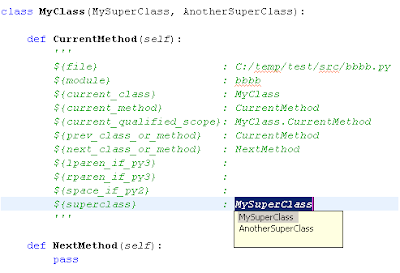
This enabled the print template to work as expected (giving only 'print ' in python 2.x and 'print()' in python 3.x, as it can 'know' which grammar you are using).
To finish, 2 other templates were creating taking advantage of the context:
super : super(MyClass, self).CurrentMethod()
super_raw : MySuperClass.CurrentMethod(self)
If anyone has other 'must have' template suggestions now that this is available, those are very welcome.
On a side note, the current nightly build is pretty stable (and should be the new released version unless there's some critical error lying there found in the next 2-3 days), so, it should be safe to get it to experiment with those.
It opens lots of possibilities, as when it's resolved it has access to the python code being edited (and all the available modules and Pydev APIs).
Some default templates were added already taking advantage of that (see: pytemplate_defaults.py as a reference -- the docstring explains how to create your own templates).
The image below shows the variables created in the defaults (already using Jython scripting -- note that when multiple superclasses are available, the ${superclass} variable enables the user to choose which one to use):

This enabled the print template to work as expected (giving only 'print ' in python 2.x and 'print()' in python 3.x, as it can 'know' which grammar you are using).
To finish, 2 other templates were creating taking advantage of the context:
super : super(MyClass, self).CurrentMethod()
super_raw : MySuperClass.CurrentMethod(self)
If anyone has other 'must have' template suggestions now that this is available, those are very welcome.
On a side note, the current nightly build is pretty stable (and should be the new released version unless there's some critical error lying there found in the next 2-3 days), so, it should be safe to get it to experiment with those.
Wednesday, December 09, 2009
Pydev 1.5.2 and 1.5.3 released
Just to note, Pydev 1.5.3 was a 1 bug fix release, fixing an annoying bug (an error would be print to the console when running on python -- although everything would still work as expected).
As for 1.5.2, the changes were focused a lot on memory and performance improvements (special thanks to the Eclipse Memory Analyzer, it really helped a lot).
Basically, Pydev had some memory peaks when analyzing modules, because it expected Eclipse to properly manage Jobs created (which are basically threads managed by Eclipse), but it turns out things were not so straightforward, so, say that you changed 500 files (in a source-format operation), it would happily go on and try to create 500 threads in the analysis (that's now fixed).
Other memory savers were targeted at handling Strings (which are 'sort of' internalized now when parsing the code, but without using PermGen space). And not keeping references to Tokens from the parsing alive (because any reference to any Token would keep all alive).
On the performance side, some changes were done to the grammar to make it a bit faster (that area had already been profiled a lot, so, there are not many performance improvement opportunities there).
Aside from that, the compare editor now has proper syntax highlighting, indentation handling and code completion from the Pydev editor. And as usual, some other minor niceties and bug fixes are available.
As for 1.5.2, the changes were focused a lot on memory and performance improvements (special thanks to the Eclipse Memory Analyzer, it really helped a lot).
Basically, Pydev had some memory peaks when analyzing modules, because it expected Eclipse to properly manage Jobs created (which are basically threads managed by Eclipse), but it turns out things were not so straightforward, so, say that you changed 500 files (in a source-format operation), it would happily go on and try to create 500 threads in the analysis (that's now fixed).
Other memory savers were targeted at handling Strings (which are 'sort of' internalized now when parsing the code, but without using PermGen space). And not keeping references to Tokens from the parsing alive (because any reference to any Token would keep all alive).
On the performance side, some changes were done to the grammar to make it a bit faster (that area had already been profiled a lot, so, there are not many performance improvement opportunities there).
Aside from that, the compare editor now has proper syntax highlighting, indentation handling and code completion from the Pydev editor. And as usual, some other minor niceties and bug fixes are available.
Tuesday, November 24, 2009
PyQt4 bug preventing it from working properly in Pydev (and workaround)
Hi All,
There have been some reports on people with problems to get PyQt4 working properly in Pydev... This is because depending on the version of PyQt4 it has a major bug that will crash a Python interpreter (this was confirmed in version 4.5.4 -- haven't checked on other versions).
To know if you have a version with this problem you can check it by running the code below in an interactive session:
>>> from PyQt4.QtCore import *
>>> QSignalMapper
>>> import inspect
>>> inspect.ismodule(QSignalMapper) <-- this will make the interpreter
crash!
If that's your problem, right now you have to fix Pydev by editing
eclipse/plugins/org.python.pydev/PySrc/importsTipper.py at line 154,
changing:
"for d in dirComps:"
to:
for d in dirComps:
if d == 'QSignalMapper':
continue
Or get another PyQt4 version.
There have been some reports on people with problems to get PyQt4 working properly in Pydev... This is because depending on the version of PyQt4 it has a major bug that will crash a Python interpreter (this was confirmed in version 4.5.4 -- haven't checked on other versions).
To know if you have a version with this problem you can check it by running the code below in an interactive session:
>>> from PyQt4.QtCore import *
>>> QSignalMapper
>>> import inspect
>>> inspect.ismodule(QSignalMapper) <-- this will make the interpreter
crash!
If that's your problem, right now you have to fix Pydev by editing
eclipse/plugins/org.python.pydev/PySrc/importsTipper.py at line 154,
changing:
"for d in dirComps:"
to:
for d in dirComps:
if d == 'QSignalMapper':
continue
Or get another PyQt4 version.
Thursday, November 19, 2009
Pydev 1.5.1 released
Yeap, this release took more time than usually, but I hope it was worth it. The major things as I posted previously were related to the refactoring engine.
There were also a number of other minor problems and features done along the way.
The complete info may be found at: http://pydev.org/
So, now that it's out, what's next?
Well, the last releases were all about giving more power to the user (refactoring, jump in the debugger, app engine, merging pydev extensions to pydev, IronPython support -- did I mention that the pydev debugger is now working with the latest IronPython?), so, I think that now would be a good time to step back a little and work on ironing out the bugs and making some profiling sessions (for both speed and memory).
There were also a number of other minor problems and features done along the way.
The complete info may be found at: http://pydev.org/
So, now that it's out, what's next?
Well, the last releases were all about giving more power to the user (refactoring, jump in the debugger, app engine, merging pydev extensions to pydev, IronPython support -- did I mention that the pydev debugger is now working with the latest IronPython?), so, I think that now would be a good time to step back a little and work on ironing out the bugs and making some profiling sessions (for both speed and memory).
Subscribe to:
Posts (Atom)